
What it is
The Deringer 20 (Ames Deringer, a Watts brand) is a double check valve assembly in 2" through 8" on a 304 stainless body with integral gear-operated butterfly shutoffs and grooved ends. The 20G uses flanged OS&Y gates instead; the X suffix means oversized low-head-loss checks; the 30 is the Type II DCDA with a micro-bypass meter mounted across the body.
The standard 20 is 18.7" long from 2½" through 4", 25" at 6", 30.7" at 8", stands 7"–10½" above the pipe, and sits only 2.9" to 5.4" below it. The 20G is 32" to 45" long with OS&Y stems 19" to 39" above centerline.
What matters for the cover
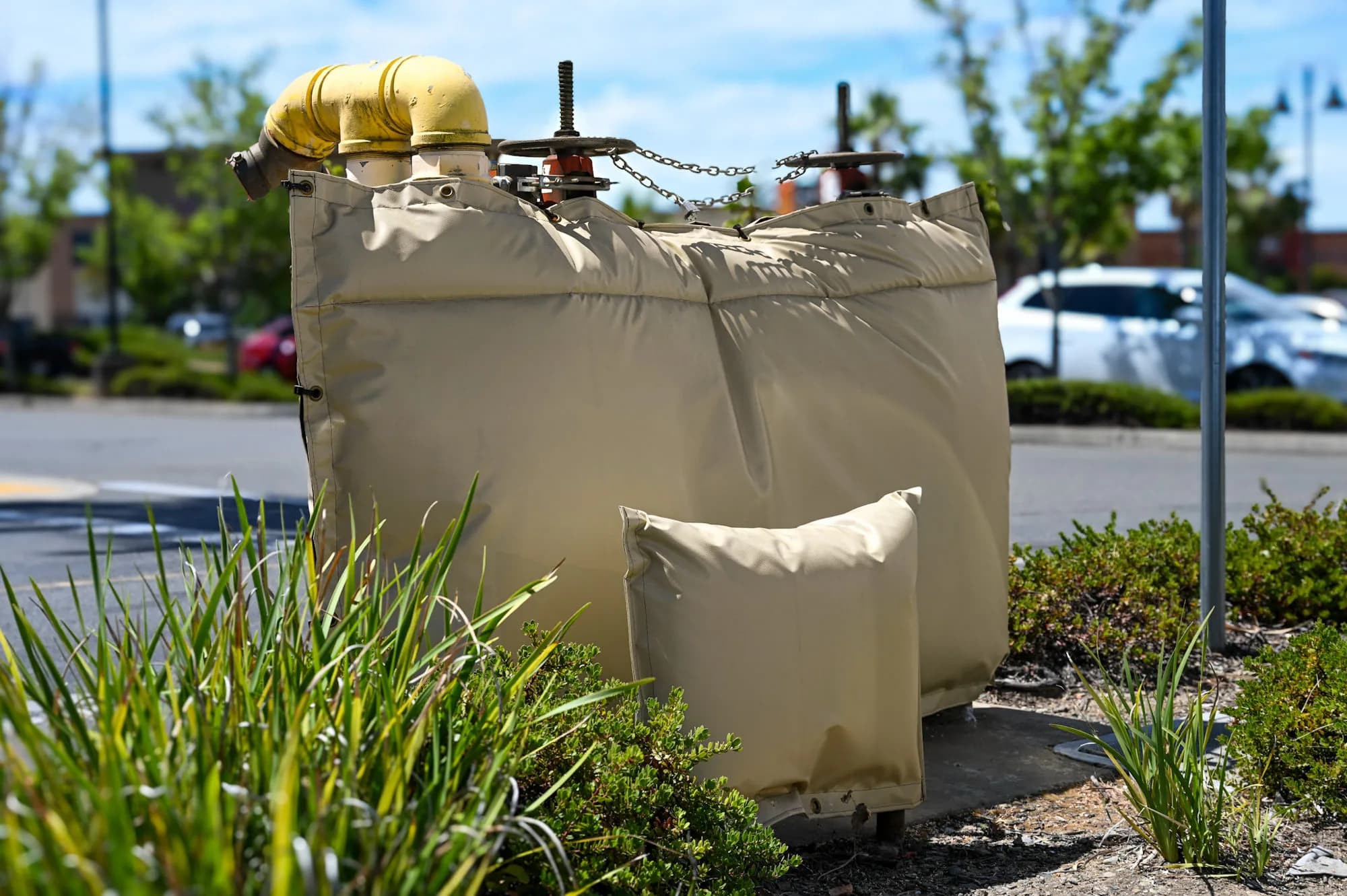
A lot of cover for a small assembly. The price list maps 3" to the 70 × 40 and 4" to the 85 × 40, and both clear a butterfly 20 with room to spare. On the compact version we will usually suggest a custom pattern that closes tighter, which holds heat better in wind. On the 20G the stock cover is the right size.
Base closes fully. A double check does not discharge. Close the cover to the pad.
The 2" is a 2½" body with adapters, 22.3" long. The 42 × 24 closed-top cover clears it.
The 30's bypass sits across the second check and barely changes the envelope. Fire lines stay charged all winter; in sustained cold that is a heat question and the fire authority's call. See fire protection.
Stocking
The 30 is the assembly Deringer is known for on fire lines with tight pads, so fire protection distributors see it at 4" and 6". The plain 20 shows up on irrigation mains and commercial low-hazard service. Same covers as the Deringer 40 size for size, which is the point: one compact family, one set of covers. The DCDA covers page covers the fire-line category.
Ordering
Name the size and the letter after 20: a plain 20 is the compact butterfly-valve unit, a 20G is flanged with OS&Y gates and roughly twice as long, and an X means oversized checks. The 70 × 40 covers 2½" and 3" of either, the 85 × 40 the 4", the 100 × 50 the 6". On the compact version, ask about the custom pattern that closes tighter.