
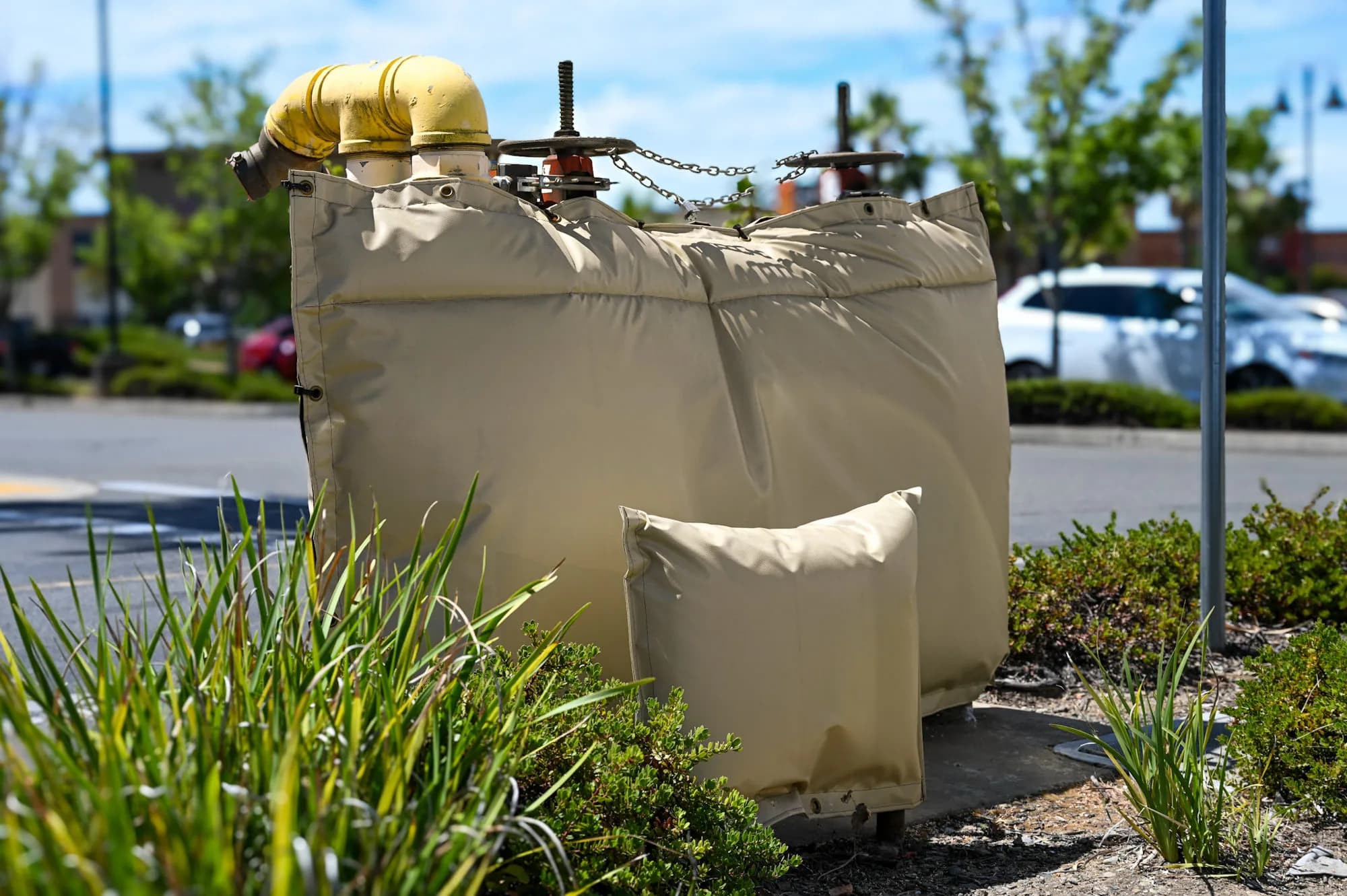
Every winter the same call comes in: "Does the city require me to cover this?" The honest answer has two layers. The model plumbing code your state adopted says something specific about freezing. Then the water utility that runs the cross-connection control program can add its own installation standard, and often does. Both matter, and they are not the same document.
The code floor: heat, insulation, or both
The International Plumbing Code says backflow preventers shall not be located in areas subject to freezing unless they can be removed by means of unions, or are protected from freezing by heat, insulation or both (IPC 2018, 2021, and 2024, §608.15.2; §608.14.2 in the 2015 edition). The same edition requires that outdoor enclosures for backflow devices comply with ASSE 1060 (§608.15.1). Read together: if you use an enclosure, it has to meet the standard; if you protect with insulation, the code names that as a method in its own right.
The Uniform Plumbing Code takes a slightly different route. In cold climate areas it calls for assemblies to be "protected from freezing with an outdoor enclosure that complies with ASSE 1060 or by a method acceptable to the Authority Having Jurisdiction" (UPC 2021 §603.4.7). That second clause is where insulated covers live in UPC states.
We wrote the whole thing up in plain English: what "heat, insulation or both" actually requires.
Where utilities go further
Utilities write installation standards because they are the ones who get the call when a frozen RP floods a meter pit or a fire line loses supervision. Some name insulation as acceptable. Some require a prefabricated insulated enclosure. A few require a heated enclosure on fire service lines and say so in the design manual. Charlotte Water, for example, requires an ASSE 1060 protective structure on every above-ground outdoor assembly and states that insulation shall not be wrapped around the assembly. Portland Water Bureau approves only commercially manufactured, prefabricated insulated enclosures. Texas irrigation rules put the RP a minimum of 12 inches above grade and require the relief valve to drain.
That range is exactly why these pages exist. A cover that is the right answer in one county is the wrong answer two counties over.
How to use these pages
Each state page gives you:
- The state-level rule and the model code the state adopted, with section numbers
- Utility examples with the actual wording where we could find it
- What each rule means for a cover: fine as-is, fine with drainage kept clear, or "this site needs an enclosure"
- Links to the fitment pages for the assemblies common in that market
Start with the states where freeze demand and code pressure are both real:
- Texas: event-driven freezes, 12-inch rule for irrigation RPs, cities writing "insulation, heat or both" into code
- Georgia: Gwinnett's heated ASSE 1060 Class I enclosure standard for containment RPs
- North Carolina: above-ground RPs, enclosures required by several utilities, Charlotte's fire-line rule
- Oregon: state rule on flood level and vaults, Portland's prefabricated-enclosure requirement
- Colorado: Regulation 11 program, a statewide IPC, Denver Water clearances, theft as a second driver
- Washington, Oregon's neighbor: mild west side, Spokane's heated-enclosure rule east
- Nevada, Utah, Arizona: the Mountain West and desert, where theft and rare hard freezes share the page
- Oklahoma: IPC language, ice storms that take the power out
- Virginia, Illinois, Ohio, New York: cold-climate states where heat is the norm on fire service and the cover is the insulation layer
- Florida: a north-and-south story, with the freeze line moving south
The counter rule that never changes
You sell products. The AHJ approves installations. When a customer asks whether a cover satisfies their code, the right move is to point them at the rule, help them read it, and document that they confirmed it. That protects the customer, and it protects you on the engineered jobs where an enclosure was specified by design.
Sub Zero Covers sells through distributors only. Stocking questions go to the distributor program; sizing questions start at the fitment hub.